
When a marriage is struggling, the first question most couples ask is "Should we get counseling?" A better first question is "What kind of counseling fits where each of us is right now?”
Couples therapy is usually the better starting point when partners are willing to work on the relationship, even if they disagree or feel discouraged. Discernment counseling is designed for a different crossroads: one partner is considering separation or divorce while the other wants to try to repair the marriage. Its first goal is clarity about what comes next, not immediate relationship repair.
Couples therapy and Discernment Counseling can look similar from the outside: two partners, one therapist, honest conversations about what has gone wrong. But they are built for very different situations. Starting with the wrong one can leave both partners feeling stuck, unheard, or more discouraged than when they began. Starting with the right one gives you the best chance at clarity, and, if you both choose it, repair.
In my previous article, Discernment Counseling: Help When One Spouse Is Considering Divorce, I explained what Discernment Counseling is and how it works. In this article, I compare it side by side with traditional couples therapy so you can decide which is the right first step for your relationship.
Couples Therapy: When Both Partners Are Willing to Work on the Relationship
Couples therapy is best for couples who are aligned in their goals. They recognize that there are problems in the marriage, but they are both committed to staying in the relationship. Each partner is willing to work to identify the problems and to repair them.
In couples therapy, both partners are engaged. They show up ready to look at their patterns, practice new ways of communicating, try the assignments between sessions, and do the work of becoming closer and more connected. The shared question is not whether to stay together, but how to make the relationship better.
Couples therapy may be a good fit if:
You both want the marriage to work, even if you are hurt, angry, or exhaustedYou agree there are problems and are open to looking at your own part in themYou are both willing to practice new skills and complete homework between sessionsYou are working through issues such as recurring conflict, communication breakdowns, emotional distance, parenting stress, or recovery from a betrayal.
Discernment Counseling: For Couples Who Want Different Things
Discernment Counseling is specifically designed for mixed-agenda couples, where one person is "leaning out" of the relationship and considering leaving through separation or divorce, and the other person is "leaning in," wanting to work on the marriage, repair the problems, and stay together.
This is a far more common situation than most people realize. Very often, the two partners arrive at the idea of counseling from completely different places: one hoping to save the marriage, the other quietly wondering whether it can or should be saved at all.
Discernment Counseling may be a good fit if:
One of you is seriously considering separation or divorce, but has not made a final decisionThe other partner wants to save the marriage and is willing to work on itYou have tried couples therapy before and it stalled or felt one-sidedYou want to make a decision about your marriage with clarity and confidence, rather than in the middle of a crisis
Discernment Counseling is generally not the right fit when one partner has already firmly decided to divorce, when one partner is being pressured or coerced into attending, or when there is domestic violence or a safety concern in the relationship.
Why Traditional Couples Therapy Often Stalls for Mixed-Agenda Couples
Traditional couples therapy can stall when one partner is not ready to work toward repair. Couples therapy assumes both people want to repair the relationship. When that isn't true, the process can quietly work against them.
The leaning-out partner often does not want to be there. They may feel ambivalent, pressured, or already halfway out the door. They may find it difficult to participate in the repair-focused exercises before deciding whether they want to remain in the relationship. Sitting through sessions focused on improving a relationship they are unsure they want can feel dishonest or even suffocating.
The leaning-in partner, meanwhile, simply cannot understand why their partner won't try. Each session can feel like more evidence of rejection, and the process becomes incredibly frustrating and hurtful. It is not uncommon for couples in this situation to leave therapy more discouraged and polarized than when they started, sometimes concluding that "even therapy didn't work," when in reality they were never in the right kind of therapy to begin with.
Discernment Counseling was created to address exactly this gap. Rather than asking the leaning-out partner to commit to repair before they are ready, it gives both partners a structured, respectful space to slow down and decide.
The Goal of Discernment Counseling: Choosing a Path
The goal of Discernment Counseling is not to save the marriage or end it. The goal is to help the couple gain clarity and confidence about the direction of their relationship. Three distinct paths are discussed in every session:
Path 1: Keep the status quo. Continue to reflect, stay where you are for now, and decide later.
Path 2: Move toward separation or divorce. If this is the path chosen, the work done in Discernment Counseling often helps couples proceed in a calmer, more thoughtful, and less adversarial way, which matters especially when children are involved.
Path 3: Commit to repair. Both partners agree to a defined period, typically six months, of all-in, intensive couples therapy aimed at restoring the relationship, with separation and divorce set aside during that time.
No path is presented as the "right" answer. Each partner is supported in making a decision they can live with, and understand, for years to come.
Key Differences in Focus, Length, and Format
Fixing problems vs. deciding whether they can be fixed
The focus of couples therapy is to identify the problems in the relationship and work to resolve them. The focus of Discernment Counseling is to understand the problems present in the relationship and decide whether they are solvable, but not to actually fix them. That work is saved for couples therapy, if both partners choose Path 3.
Taking personal responsibility
Discernment Counseling places a strong emphasis on each partner taking responsibility for their own role in the problems in the relationship. Rather than building a case against the other person, each partner looks honestly at their own contributions. This self-focus is valuable whichever path is chosen: it strengthens a repaired marriage, and it helps people avoid repeating the same patterns in future relationships.
How sessions are structured
In couples therapy, both partners are typically in the room together for most of the session. In Discernment Counseling, much of each session is spent in separate one-on-one conversations with each partner, with the couple coming together at key points. This allows the leaning-out partner to speak honestly about their doubts, and the leaning-in partner to be supported without having to hold their feelings back.
Length of treatment and sessions
Couples therapy can be a longer process of many weeks or months, usually in weekly sessions of about an hour. Discernment Counseling is a purposefully short-term protocol of generally no more than five sessions. Sessions are longer, about two hours, and include the Core Questions. Couples decide one session at a time whether to continue.
At a Glance: Couples Therapy vs. Discernment Counseling
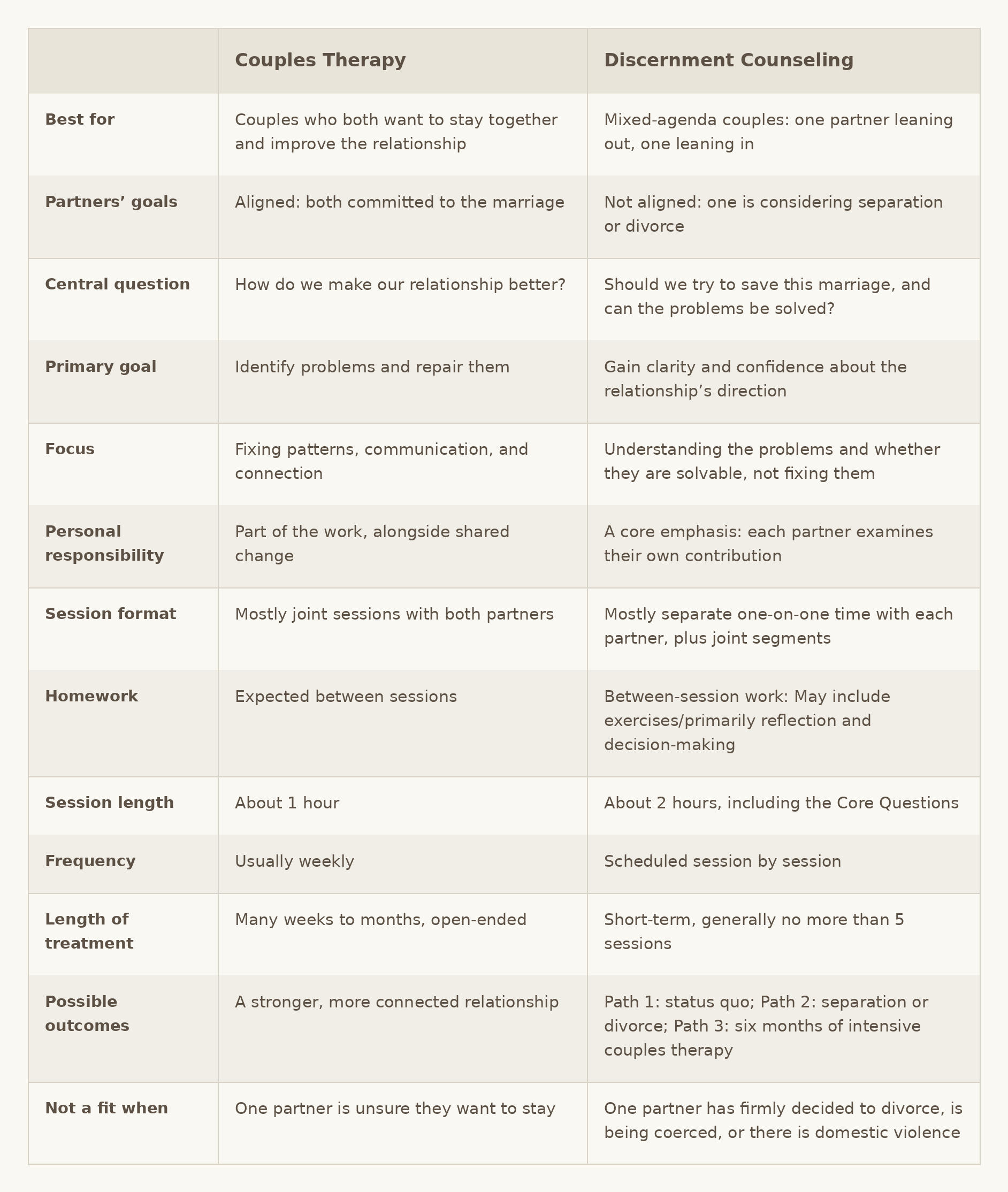
Couples Therapy vs. Discernment Counseling
Which Is the Right First Step for You?
These questions can help you sort out where you and your partner stand. Try answering them separately and honestly.
If your partner asked you today, "Do you want to stay married?", would your answer be a clear yes?Are you willing to put real effort into changing the relationship over the next several months?Has either of you spoken the words "separation" or "divorce" seriously, or thought them often?Does one of you feel much more hopeful about the marriage than the other?Have you tried couples therapy before, only to have it stall because one of you wasn't fully invested?
If you both answered yes to the first two questions, couples therapy is likely the right first step. If one of you is unsure, has been thinking seriously about leaving, or feels far less hopeful than the other, Discernment Counseling is often the better place to begin.
If you're still not sure, that's completely normal. An initial consultation can help clarify which approach fits your situation.
Taking the First Step
Choosing between couples therapy and Discernment Counseling isn't about choosing the "better" therapy. It's about choosing the approach that honestly matches where each of you is today. When both partners are all in, couples therapy offers the tools to rebuild closeness and connection. When one partner is leaning out and the other is leaning in, Discernment Counseling offers a respectful, structured way to slow down, look honestly at the relationship, and decide on a path forward together.
Whichever step is right for you, you don't have to figure it out alone. I work with couples in New York, Florida, and Connecticut, offering both couples therapy and Discernment Counseling. If you'd like to talk about which approach may be right for your relationship, I invite you to reach out to schedule a consultation.
To learn more about how Discernment Counseling works, read my previous article: Discernment Counseling: Help When One Spouse Is Considering Divorce.